Order from the Stack: Building a Personal Ranking System for Your Paper Collection
There is a particular kind of paralysis that visits the well-stocked creative studio. You stand before a drawer—or a shelf, or a flat file—filled with beautiful paper acquired over months or years, and you reach for the nearest sheet without thinking. The premium Italian cotton stock you ordered last spring sits undisturbed beneath a ream of mid-grade bond. The hand-pressed sheets from a small Vermont mill occupy the same chaotic territory as printer paper you grabbed at an office supply store. Everything is present. Nothing is organized. And so, by default, nothing is truly used with care.
The solution is not to own less paper. It is to understand what you own—and to build a system that makes the right sheet findable, accessible, and appropriate to the task at hand.
Why Taxonomy Matters More Than You Think
Professional chefs do not reach blindly into a spice cabinet. Architects do not pull random drafting tools from an unsorted bin. Yet many accomplished creatives treat their paper supply as an undifferentiated mass, governed more by what happens to be on top than by any deliberate selection process.
Creating a hierarchy for your paper collection is not a clerical exercise. It is a creative act in itself. When you force yourself to evaluate each sheet—its weight, its surface texture, its archival quality, its intended use—you develop a working vocabulary for your own materials. That vocabulary, in turn, shapes how you approach every project that follows.
A ranking system also protects your investment. Premium paper is not inexpensive, and it deserves to be used in contexts where its qualities are genuinely engaged. A 300 gsm cold-press watercolor sheet from a specialty mill performs differently than a 90 gsm smooth writing stock, and using either one carelessly—or interchangeably—wastes both the material and the opportunity it represents.
The Three-Tier Framework
While any system can be tailored to individual practice, a three-tier framework provides a useful starting point for most creatives.
Tier One: Everyday Working Stock
This is your drafting paper, your note-taking paper, your rough-sketch paper. It should be accessible, relatively affordable, and guilt-free. The purpose of Tier One is to remove friction from the early stages of any creative process. When brainstorming, journaling, or working through compositional problems, you should not feel precious about what you're writing on. Good quality still matters here—a smooth, consistent surface reduces physical resistance and keeps your hand moving—but these sheets are not meant for final work or formal presentation.
Examples might include a reliable 20 lb writing bond, a sturdy newsprint pad, or a mid-weight sketch paper in a standard size. Keep these in an immediately reachable location.
Tier Two: Project-Specific Stock
Tier Two is where specialization begins. These sheets are selected for their particular performance characteristics: a laid finish for correspondence, a textured watercolor paper for mixed-media work, a heavyweight cardstock for handmade books or portfolios. They are not reserved for rare occasions, but they are chosen deliberately for the project at hand.
When building your Tier Two inventory, think in terms of medium and method. If you work primarily in ink, what weights and finishes perform best under your preferred pen? If you produce hand-lettered pieces, which papers hold a clean edge without feathering? Sorting your collection by these functional criteria—rather than by acquisition date or where the package happened to land—makes Tier Two sheets genuinely useful rather than aspirationally stored.
Tier Three: Ceremonial and Archival Sheets
This is the category most creatives handle worst. Tier Three encompasses your finest acquisitions: the limited-edition handmade sheets, the archival cotton rag stock, the specialty papers you ordered for a specific commission or occasion. These are not display items. They are not trophies. They are tools—exceptionally refined tools—that deserve to be used in work of corresponding ambition.
The mistake many creatives make is treating Tier Three paper as too precious to touch. The opposite approach is more productive: designate specific projects or occasions that are worthy of these sheets, and then use them without apology. A Tier Three sheet used well honors the craft of its making. A Tier Three sheet left indefinitely in a drawer does not.
Practical Steps for Building Your System
Begin with a full inventory. Remove every sheet, pad, and ream from your storage and lay them out where you can see them. This step alone tends to produce revelations—both about what you have forgotten you own and about the sheer variety of materials that have accumulated without a coherent plan.
Next, evaluate each item against three criteria: weight, finish, and intended use. Weight (measured in pounds for bond paper or grams per square meter for most specialty stock) determines durability and tactile presence. Finish—smooth, vellum, laid, textured, cold-press, hot-press—determines how the surface interacts with your medium. Intended use is the category that requires the most honest self-assessment. Ask yourself not what you might theoretically do with a sheet, but what you are actually likely to do with it, given your current practice.
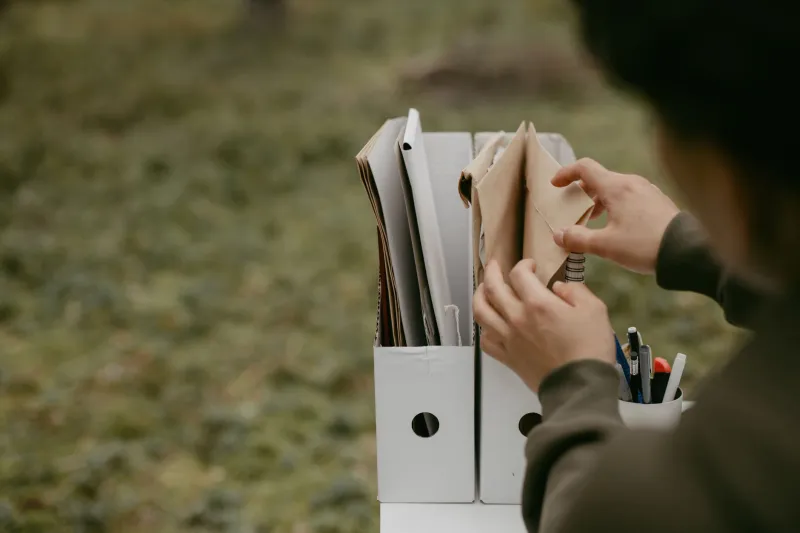
Once sorted, store each tier separately and label it clearly. Flat files work beautifully for larger sheets. Labeled accordion folders or document boxes serve smaller formats well. The goal is immediate visual identification—when you are ready to work, you should be able to reach for the appropriate tier without searching.
Finally, review your inventory seasonally. Paper stocks change. Your practice evolves. What belonged in Tier Two a year ago may have earned a Tier Three designation as your skills have grown, or may have been demoted to Tier One as your work has moved in a new direction.
The Deeper Value of Deliberate Organization
A well-organized paper collection does something beyond improving workflow efficiency. It makes you a more conscious maker. Every time you select a sheet with purpose—because you have thought through its properties and matched them to your intentions—you bring a degree of deliberateness to your work that accumulates over time.
The creatives who extract the most from premium paper are not necessarily those who own the most of it. They are the ones who understand what they have, who have taken the time to build a personal taxonomy that reflects their actual practice, and who reach for each sheet knowing exactly why it is the right choice for this moment, this project, this work.
Organization, in this sense, is not the enemy of spontaneity. It is what makes true spontaneity possible—because when your materials are in order, your attention is free to remain exactly where it belongs: on the work itself.