Written in the Margins: How Serious Readers Are Reclaiming Annotation as a Paper Practice
The Margin as a Thinking Space
There is a particular kind of thought that only happens when a pen meets paper at the edge of a printed page. It is not the thought of someone passively consuming text. It is the thought of someone actively wrestling with it — questioning a premise, extending an argument, flagging a contradiction, or simply noting that something deserves a second reading. The margin, in this sense, is not wasted space. It is where understanding is built.
For several years, digital tools promised to replace this practice entirely. Annotation software, PDF markup platforms, and e-reader highlighting systems offered the appeal of searchability, cloud synchronization, and color-coded organizational schemes. Many professionals adopted them willingly. A growing number are now moving back.
What Digital Markup Gets Wrong
The limitations of digital annotation are not immediately obvious. On the surface, the tools are capable: you can highlight, comment, tag, and share with relative ease. The problem emerges over time, and it tends to emerge in the same way for most people who describe the experience.
"I would go back to a document I had annotated months earlier and find dozens of highlights with almost no memory of why I had marked them," says one independent researcher who works primarily in policy analysis. "The act of clicking to highlight had felt like thinking, but it wasn't. I had confused the gesture of marking with the act of engaging."
This observation aligns with what cognitive scientists have studied in the context of learning and memory. The physical act of writing — forming letters, choosing words, exerting pressure on a surface — activates neural pathways that passive clicking does not. When a reader writes a marginal note by hand, the brain is encoding information through multiple sensory channels simultaneously. The result is stronger retention, more nuanced recall, and a more personal relationship with the text itself.
Digital tools, by contrast, tend to flatten the annotation experience. Every highlight looks the same. Every comment appears in an identical font. The visual and tactile uniformity of the interface works against the reader's attempt to create a meaningful record of their thinking.
The Return to Paper
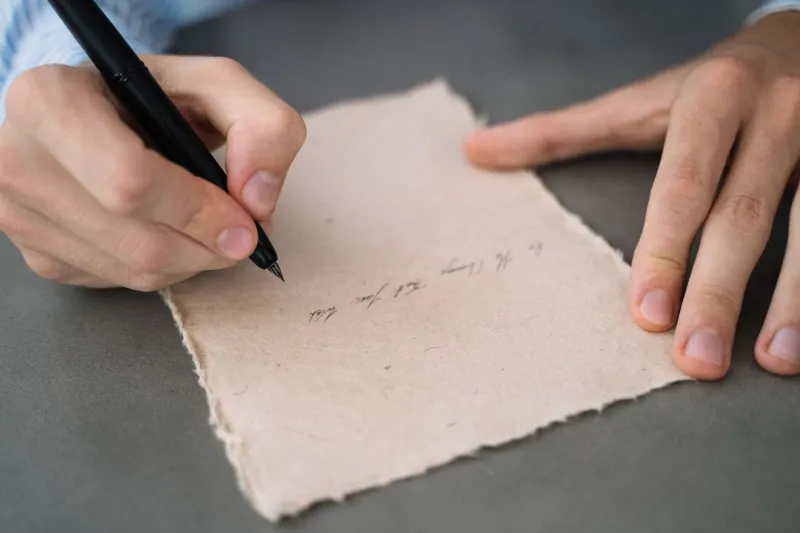
For writers, researchers, editors, and business professionals who depend on their relationship with text, the return to paper annotation is not nostalgic. It is functional. The margin note, written by hand on a physical sheet, carries information that a digital comment cannot: the pressure of the pen, the size and slant of the handwriting, the placement on the page, the visible second-guessing of a crossed-out word. Each of these details is a record of how the reader was thinking at the moment of engagement.
A literary editor working in New York describes her system this way: "I use a fine-tipped pen for precise notes and a broader nib for larger structural observations. I draw brackets when I want to isolate a passage, and I use a specific symbol — a small open circle — to mark anything I want to return to during a second pass. It took me years to develop this system, and it works because it is mine. No app has ever given me that."
This kind of personalized markup language is one of the most compelling arguments for paper annotation. Because the physical act of writing is inherently slower and more deliberate than typing, readers tend to develop shorthand systems that reflect their individual intellectual habits. These systems become more refined over time and more legible to the person who created them — which is, after all, the primary audience for most margin notes.
Choosing Paper That Supports the Practice
Not every sheet is equally suited to serious annotation work. The paper itself plays a significant role in the quality and longevity of handwritten notes, and professionals who have committed to a paper-based markup practice tend to be specific about what they require.
Weight and opacity are among the first considerations. A sheet that is too light will allow ink to bleed through, compromising both the readability of the annotation and the integrity of the text beneath it. For documents intended to be marked up extensively, a weight of at least 24 lb bond — and ideally 28 lb or higher — provides the stability that sustained annotation demands.
Surface texture matters equally. A sheet with too much tooth will cause certain pen nibs to skip or catch, disrupting the flow of handwriting. A surface that is too smooth may cause ink to spread slightly before drying, softening the precision of finer script. A medium-finish cotton or wood-free sheet tends to offer the balance that most annotators prefer: enough texture to provide feedback to the hand, smooth enough to allow fluid, legible marks.
Ink compatibility is a practical concern that is frequently underestimated. Fountain pen users in particular should seek papers that are specifically tested for minimal feathering and bleed-through. Many premium papers marketed toward calligraphers or correspondence use will perform well in this regard. Papers with higher cotton content are often more forgiving of wetter inks and allow for a cleaner, more defined line.
Archival quality becomes relevant for anyone who maintains a research archive or returns to annotated documents over years rather than months. Acid-free papers will not yellow or become brittle over time, ensuring that margin notes written today remain legible and structurally intact a decade from now.
Building a Markup Practice Worth Keeping
For those considering a return to physical annotation, the transition is less about abandoning digital tools entirely and more about being deliberate about when each approach serves the work. Digital markup remains practical for quick reference documents or collaborative review processes. But for deep reading — for the kind of sustained engagement with a text that produces genuine insight — paper offers something qualitatively different.
The margin is not simply a place to record what you noticed. It is a place to record who you were when you noticed it: how confident, how uncertain, how curious, how skeptical. That record, written in your own hand on a sheet that holds the mark of your pen, is a document of thinking that no screenshot or exported PDF comment thread can replicate.
The professionals returning to this practice are not doing so out of sentiment. They are doing so because it works — because the quality of their engagement with difficult material improves when they bring a good pen to a good sheet and allow the margin to do what it was always designed to do.